 EarthArtEther
Pumpkin Life Cycle for Kids: Stages, Activity and Printable
The pumpkin life cycle for kids, from seed to flower to pumpkin, with a hands-on pumpkin investigation, roasted seeds and a free printable pack.
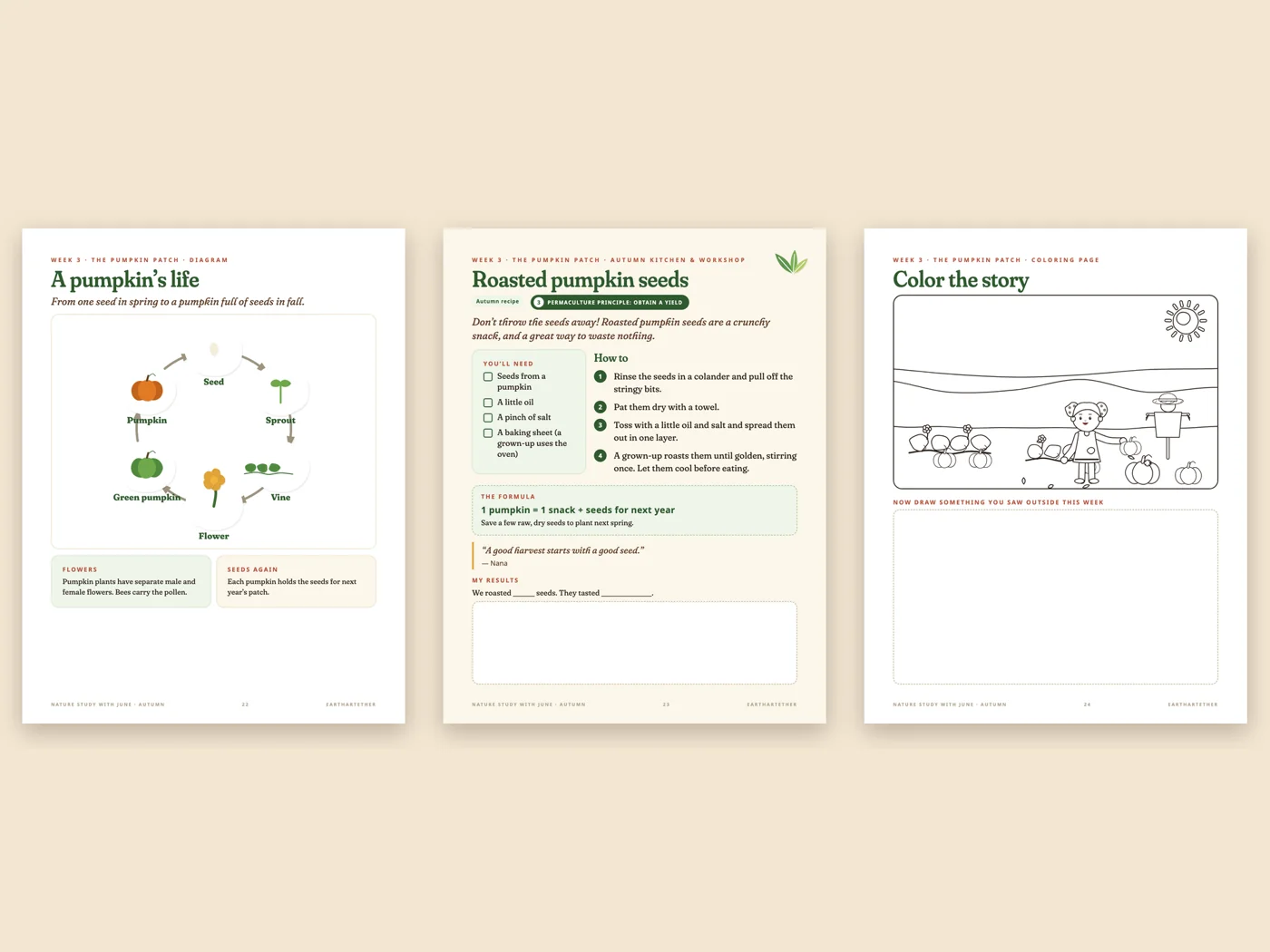
The pumpkin life cycle goes seed, sprout, vine, flowers, green pumpkin, ripe pumpkin, and then seeds again. Depending on the variety, pumpkins ripen about 90 to 120 days after planting. The easiest way for children to understand it is to hold a real pumpkin, open it up, and find the seeds that start the whole circle over.
Below you’ll find the stages explained simply, a pumpkin investigation for the kitchen table, and roasted pumpkin seeds to finish. If you’d like pages to go with it, the free 4-page Pumpkin Life Cycle Pack is on our free printables page.
The pumpkin life cycle stages, explained for kids
Read these aloud and let your child point to each stage on a drawing, or act them out from a crouch to a big round pumpkin.
1. Seed
Every pumpkin starts as one flat seed. A handy planting rule: plant a seed 2 to 3 times as deep as it is wide. Always check the seed packet first, because the packet wins when it disagrees.
2. Sprout
The seed sprouts, and a small seedling pushes up through the soil.
3. Vine
The seedling grows into a long vine with curly tendrils. This is a good stage to measure if you have a garden patch. It’s fun to see how far one vine can travel.
4. Flowers, and why pumpkins need bees
Pumpkin plants grow male flowers and female flowers on the same vine. Male flowers usually open 1 to 2 weeks before the female ones. Here’s a detail children enjoy hunting for: a female flower has a tiny pumpkin at its base.
Pumpkin pollen isn’t carried by the wind, so the plant needs bees to move pollen from flower to flower. In most of North America, native squash bees do most of the pollinating. Honey bees and bumble bees help too. If you have pumpkins growing, sit quietly near the flowers and see who visits.
5. Green pumpkin
Once pollen reaches the female flower, the tiny pumpkin at its base can grow. This is why a pumpkin is a fruit to a botanist: a fruit is the part that grows from the flower and holds the seeds.
6. Ripe pumpkin
The green pumpkin slowly turns orange. From planting to ripe pumpkin usually takes about 90 to 120 days, depending on the variety, so check the seed packet for yours.
7. Seeds again
Cut a ripe pumpkin open and the circle is complete. Each pumpkin holds the seeds for next year’s patch.
A simple pumpkin investigation (pumpkin life cycle activity)
This is the heart of pumpkin week. The pattern is always the same: guess first, then find out. A guess written on paper turns every measurement into a small mystery.
What you need
- A pumpkin
- A tape measure and a kitchen scale
- A big spoon and a bowl
- A tub of water big enough for the pumpkin
- Paper and a pencil for guesses and findings
Steps
- Measure around the middle of the pumpkin. Write down a guess first, then the real number.
- Weigh it, again guessing first.
- Count the lines that run from the stem to the bottom.
- Guess: will it sink or float? Then test it in the tub of water. Let the pumpkin give the answer.
- A grown-up cuts off the top with a sharp knife. Children scoop the seeds into the bowl.
- Guess how many seeds are inside, then count them.
- Save the seeds for roasting, and set aside a few to plant next spring.
Questions to talk about
- How did one seed make so many?
- Why did the pumpkin float (or sink)?
- Who helped the pumpkin grow?
For different ages: a 5-year-old can simply measure the pumpkin and draw it, outside and inside. An older child can count every seed by making piles of 10, then see how close the guess was.
Roasted pumpkin seeds, with a grown-up at the oven
Roasting the seeds is a tasty way to make sure nothing goes to waste.
Safety first: a grown-up uses the oven. Hot pans can burn, so children help with the rinsing, drying and tossing, then step back.
What you need
- Seeds from your pumpkin
- A little oil
- A pinch of salt
- A baking sheet
Steps
- Rinse the seeds in a colander and pull off the stringy bits.
- Pat them dry with a towel.
- Toss them with a little oil and salt, then spread them out in one layer.
- A grown-up roasts them at 350 °F for 15 to 25 minutes, stirring about every 5 minutes, until golden.
- Let them cool before eating.
If you like, a grown-up can first boil the seeds for 10 minutes in salted water. University of Illinois Extension notes this optional step helps them roast evenly.
Designing like nature does: what pumpkins teach
Permaculture is a way of designing gardens and homes by watching how nature works. Two of David Holmgren’s permaculture principles fit pumpkin week well. “Obtain a yield” asks every planting to give something back, and one seed in spring becomes a pumpkin full of seeds by fall. “Produce no waste” is the roasted seeds: the part many families throw away becomes a snack, and a few seeds become next year’s garden.
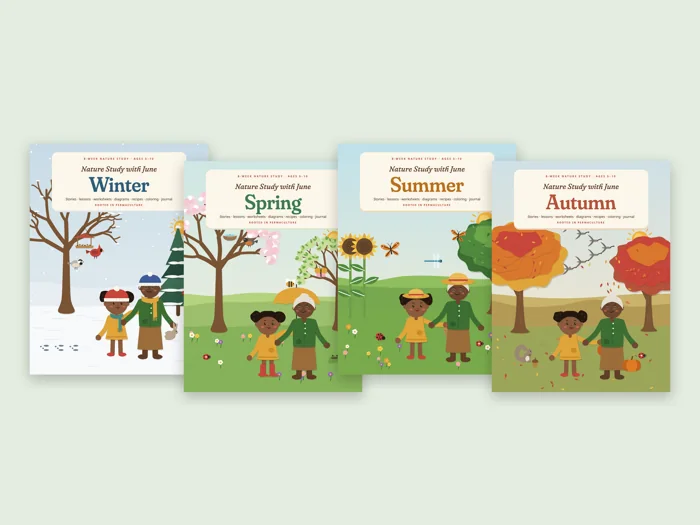
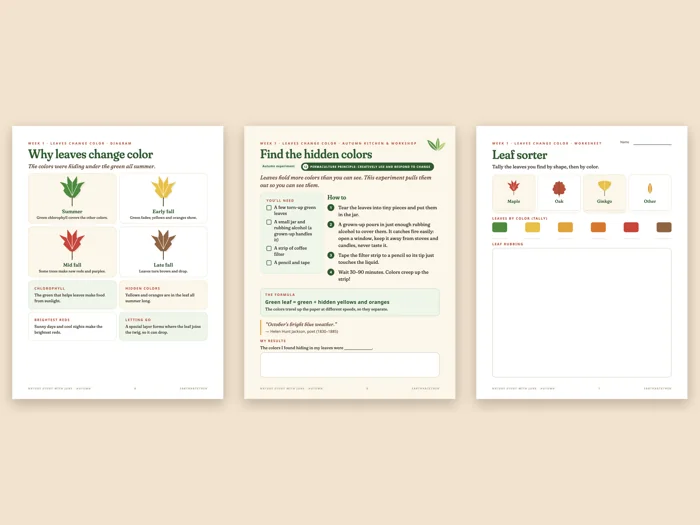
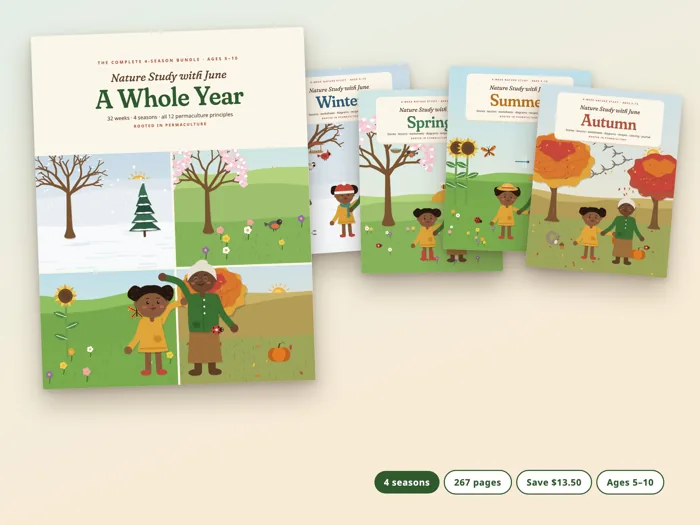
If you’d like the full 8-week fall study, pumpkins are week 3 of Nature Study with June: Autumn, with a story, a pumpkin investigation worksheet, a labeled life cycle diagram and a journal page. For more fall science, try our leaf color experiment, or read how to start nature study with kids for a simple weekly rhythm.
Frequently asked questions
Is a pumpkin a fruit or a vegetable?
Both answers are fine, as long as you say why. To a botanist, a pumpkin is a fruit because it grows from the flower and holds seeds. In cooking, and on the USDA’s MyPlate, it counts as a vegetable. Pumpkins belong to the gourd family, so pumpkins, squash and gourds are cousins.
Why does my pumpkin vine have flowers but no pumpkins?
Look under the flowers. Only female flowers have a tiny pumpkin at the base, and male flowers usually open 1 to 2 weeks earlier, so the first flowers you see may all be male. Pumpkin pollen isn’t carried by the wind, so the flowers also need visits from bees.
How long does it take a pumpkin to grow?
About 90 to 120 days from planting to ripe pumpkin, depending on the variety. The seed packet will give the number for your kind.
Can we plant the seeds from our pumpkin?
You can, but the new plant may surprise you. Seeds from hybrid plants may grow into plants that look different from the parent, and squash-family plants cross easily with their neighbors. Seeds from open-pollinated or heirloom plants are the best bet for growing the same kind again. Plant them 2 to 3 times as deep as the seed is wide.
Whenever you’re ready, the free Pumpkin Life Cycle Pack is waiting on the free printables page.